Contact Us
Reach out to our global team for a customized digital marketing solutions!





 2026/04/15
In China, consumer discovery rarely begins with a simple search engine query. Instead, it unfolds within super-app ecosystems, where everyday tools double as decision engines. Today, maps have transcended their original purpose as basic navigation aids. They now influence where people eat, shop, and spend their time. In practice, they function as search engines, review platforms, local discovery tools, and even triggers for commerce. Most importantly, every location signal carries purchase intent in its purest form.
For many international companies, the primary challenge remains how to reach Chinese consumers who operate within a fragmented, largely self-contained digital ecosystem. This is where Amap (often referred to in China as Gaode Map or 高德地图) provides the high-speed on-ramp to consumer intent. It serves as a direct bridge between digital search and real-world transactions, making it a critical tool for brands looking to establish a physical presence in the market.
With nearly 900 million monthly active users and its recent evolution into an AI-enhanced platform, it is no longer just a GPS. Amap has become a gateway to the modern Chinese lifestyle. For global brands, this presents an opportunity to stay top of mind as these consumers travel. Whether navigating their home cities or exploring international destinations, the platform serves as a familiar digital companion that guides the discovery of brands and services worldwide.
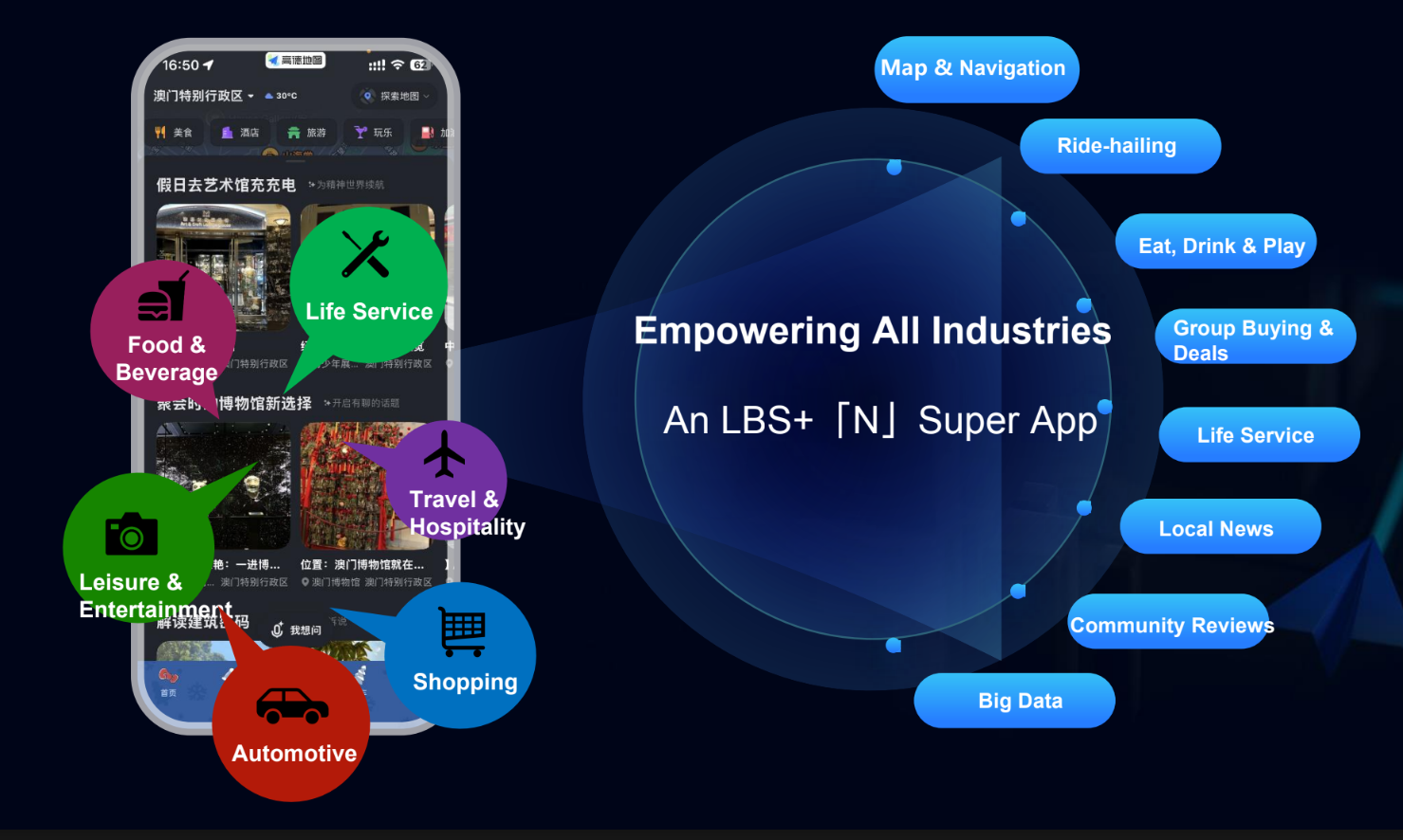
Owned by Alibaba, Amap is China’s leading digital mapping and navigation platform. While global audiences know it as Amap, the platform originally launched in 2002 as a digital mapping service before evolving into a full lifestyle discovery hub. And as it nears the billion MAUs milestone, Amap now ranks alongside giants such as WeChat, Douyin, and Baidu in scale.
Key Highlights of Amap:
• Smart Navigation: Real-time guidance for driving, cycling, walking, and public transit.
• Seamless Ride-Hailing: Book taxis or compare services like Didi and T3 directly within the app.
• Comprehensive Transit Info: Access metro maps, bus timetables, and transfer suggestions across major cities.
• Local Discovery: Explore nearby shops, restaurants, and attractions with photos and user reviews.
• Indoor Wayfinding: Navigate effortlessly inside malls, airports, and train stations.
So, what is Amap in the context of a marketing stack? Think of it as a location-intelligence ecosystem that integrates ride-hailing, hotel bookings, and restaurant reviews into a single interface. The platform has moved seamlessly from answering “Where am I going?” to enabling users to ask “What should I buy when I get there?” through features like its AI-powered Street Stars rankings, which now serve over 660 million users with real-time dining and activity guides. More impressively, its influence also extends beyond China. As of 2026, Amap/Gaode Map has mapped over 200 countries and territories in English, Simplified, and Traditional Chinese, providing a familiar interface for Chinese travellers wherever they go. For brands, this makes Amap a powerful digital gateway for location-based marketing and high-intent engagement.
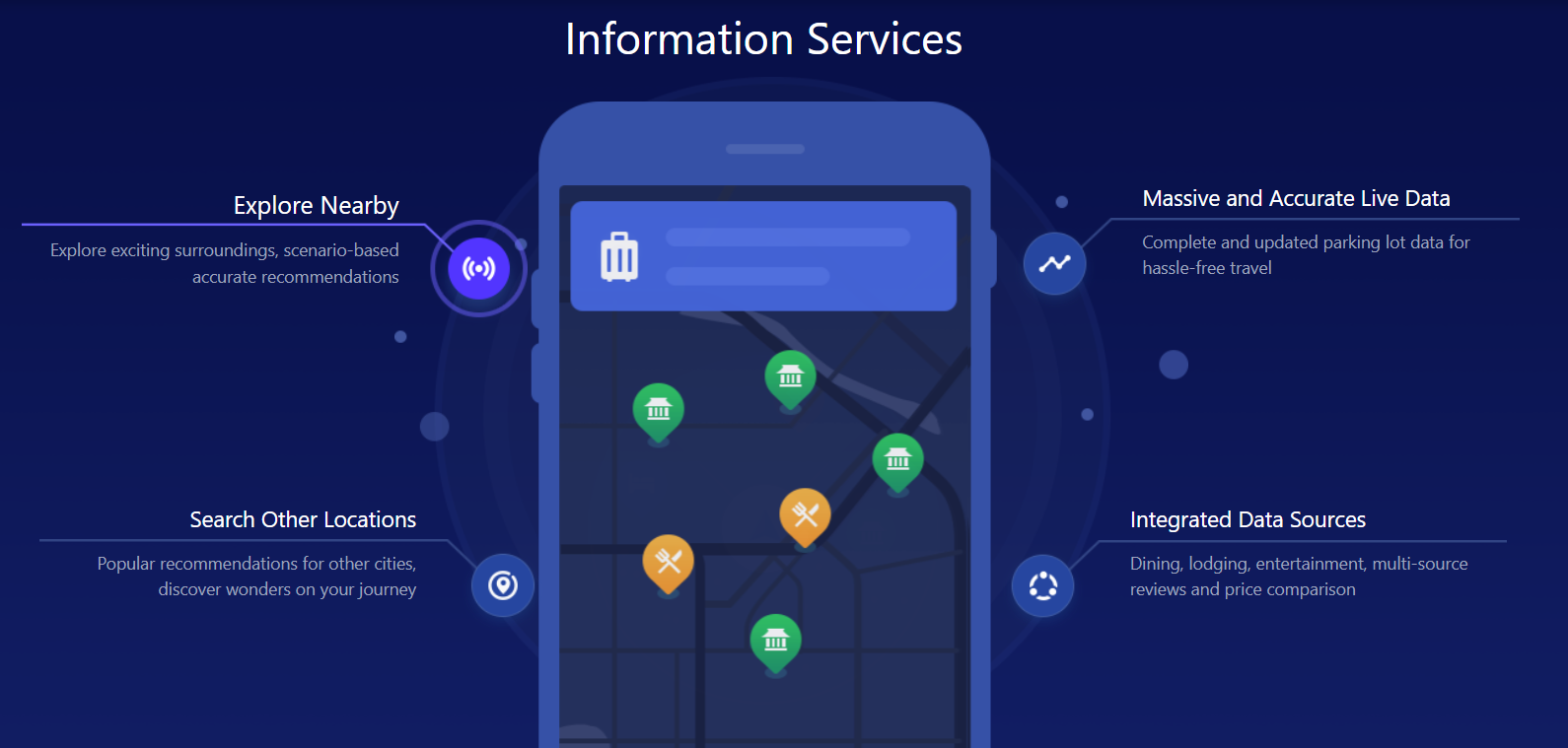
The shift toward location-based marketing is driven by the fact that geographic data is often more predictive compared to interest-based data. For instance, a user browsing a luxury fashion brand’s social media page might be an enthusiast, but a user searching for that brand’s specific boutique location on Amap/Gaode Map is likely signalling a decision-ready moment.
This is the power of location-based services (LBS) advertising. It shortens the distance between discovery and footfall. And in a market where most users access the internet via smartphones, being visible at the exact moment a consumer plans their route is vital. This is the point at which they are most receptive.
Consider a nearby restaurant activating search result ads on Amap during lunchtime. The targeting is not based on inferred demographics but on proximity, timing, and immediate intent (hunger). Digital engagement converts directly into physical visits. Media spend can then be measured directly against store traffic.
Amap’s advantage lies in intent-driven behaviour. Navigation queries, Point of Interest (POI) searches, route planning, and nearby recommendations all correspond to real-world decision stages. In 2026, this is further enhanced by Xiao Gao, the platform’s AI-native mobility agent. Unlike static social or display media, this "travel partner/assistant” provides proactive suggestions based on real-time context, capturing intent in motion and turning local searches into commercial outcomes.

A recurring obstacle for global retailers is the disconnect between online awareness and offline conversion. Fragmented platforms, walled digital ecosystems, and cultural nuances mean consumers rely heavily on high-utility services they trust in their daily routines. Amap helps bridge this gap by embedding itself into those routines. As part of the wider Alibaba ecosystem, it draws on extensive behavioural data that allows businesses to better understand and reach their target audiences.
While many Western platforms capture a user's general interest, Amap captures intent in motion through a “Full-path User Reach” strategy. This framework enables brands to appear at the exact moment a decision is taking shape, regardless if it’s the pre-trip itinerary planning or in-trip decision making at the destination. Whether a traveller is searching for a nearby pharmacy or a resident is planning a weekend shopping trip, the platform provides the trust and utility that guide users towards a final purchase decision. Because Amap operates as a familiar “travel assistant” across hundreds of global destinations (Such as Hong Kong, Japan, Korea, Thailand, and Malaysia), it allows international brands to maintain a consistent presence even as these consumers cross borders. For brands, this connection between real-world behaviour and digital discovery makes Amap a particularly powerful tool to reach the global Chinese diaspora.
Compared with other mapping platforms, including those often referenced in discussions of Amap vs. Baidu Map, the key difference lies in the depth of commerce integration. Alibaba has embedded e-commerce and local services directly into the Amap interface, allowing users not only to locate a shop but also to access exclusive vouchers or place “order-ahead” purchases without leaving the app.
This level of spatial intelligence expands Amap’s role far beyond navigation. From F&B and retail to automotive and healthcare, the platform supports a wide range of consumption scenarios. For brands, this transforms Amap into a thriving decision environment where discovery, planning, and purchasing intersect within a single interface.
The platform is also advancing the role of intelligent navigation. Amap recently introduced Xiao Gao, the world’s first AI-native map agent. Rather than simply helping users plan routes, Xiao Gao delivers proactive recommendations based on real-world context such as weather conditions, time of day, and past spending behaviour.
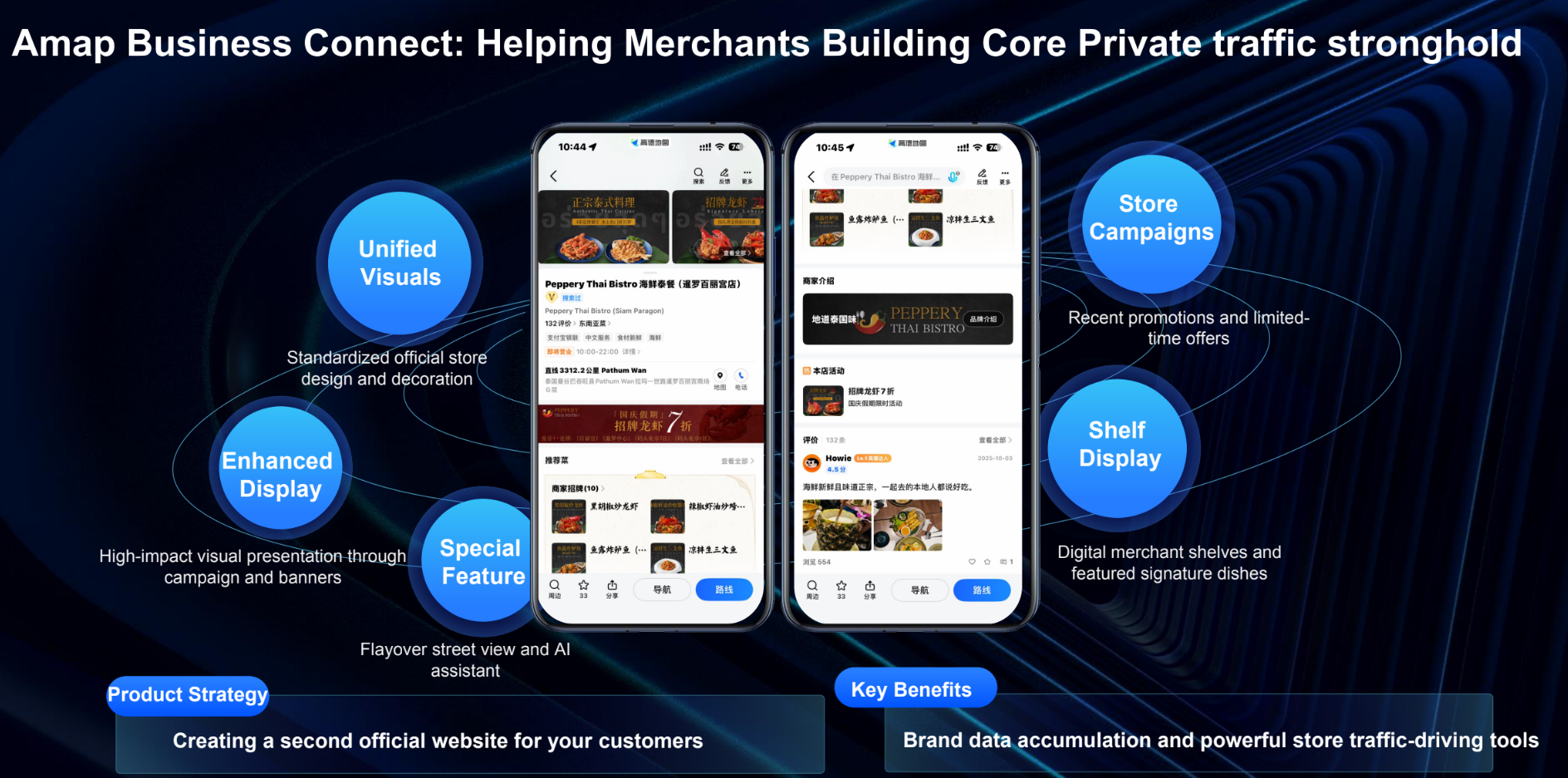
Before deploying paid media, brands must first establish a high-impact organic presence. Amap Business Connect allows merchants to build a "private traffic stronghold" by transforming their standard map listing into a digital flagship store. Utilising Unified Visuals for standardised store design and enhanced displays for high-impact banners, brands can create a professional "second official website" that drives data accumulation and powerful store traffic.
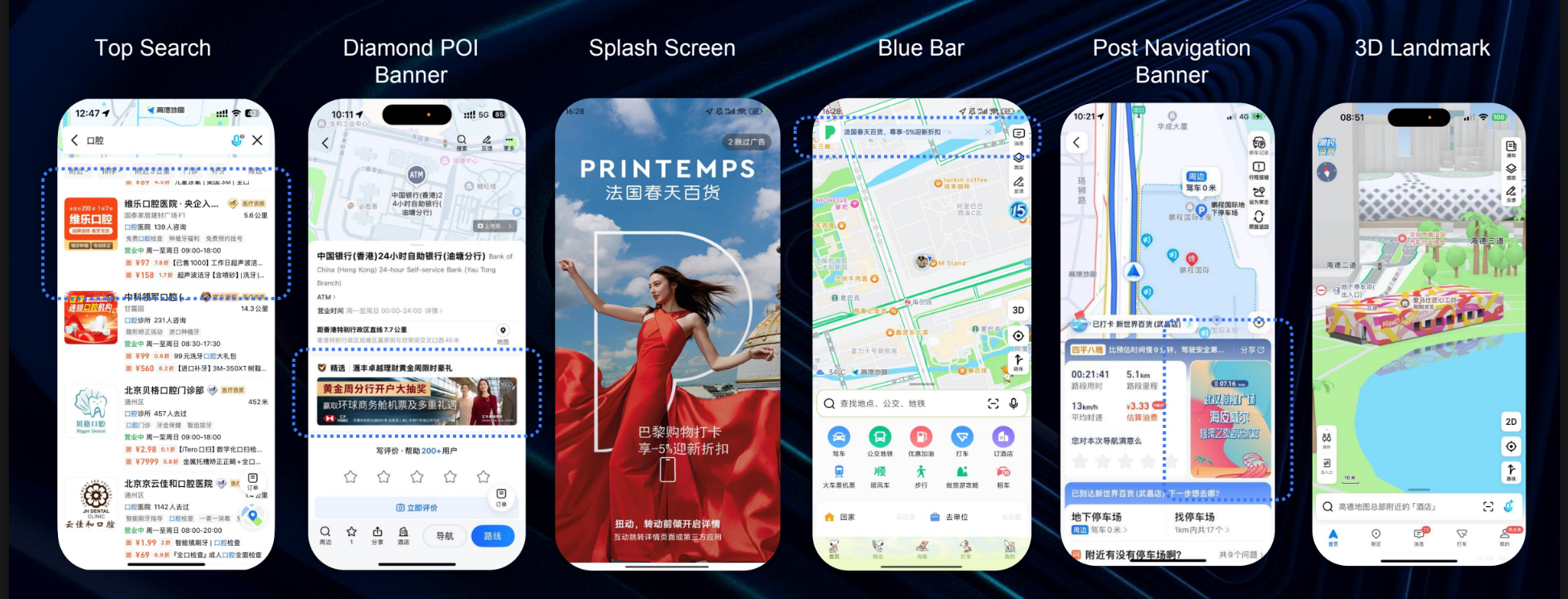
To move from strategy to tactics, brands must also understand the varied LBS advertising formats available. These solutions allow location-based marketing to appear as a helpful service within the user journey rather than a disruptive advertisement.
Core Amap advertising formats include:
• Splash Screen: Full-page ads displayed during app launch
• Diamond POI Banner: Displaying the promotional banner upon POI search to drive traffic to brands.
• Top Search: Positioning a brand at the top of the list when a user searches for a relevant category.
• Post Navigation Banner: Engaging users during route planning with interactive formats.
• 3D Landmark: Highlighting the offline event by presenting it in an immersive 3D way.
Beyond advertising, the Amap ecosystem provides a suite of LBS developer tools, including Places APIs and Dynamic Maps, allowing brands to embed high-precision location intelligence directly into their own digital platforms.
Precision Targeting & Location Intelligence
Amap supports real-time proximity targeting, behaviour-based targeting, time and location triggers, and geo-fencing strategies. These capabilities make marketing to specific customers based on their location both measurable and highly precise. Geo-targeting advertising ensures campaigns reach consumers at the exact moment their intent is strongest.
Brands across sectors are leveraging location-based marketing and LBS advertising to drive tangible results. The following examples illustrate how different industries can activate the platform.
Use Case #1: Increase footfall with real-time store promotions for retail & FMCG
A global sportswear brand uses geo-fencing to trigger high-impact full-page takeovers for users within a 1 km radius of their flagship store. Instead of a generic ad, users nearby receive a real-time digital invitation for an exclusive in-store customisation session. This approach effectively turns a nearby walk into a compelling reason to visit the store.
Use Case #2: Capture lunchtime demand for F&B through POI and search result ads
An international coffee chain targets users searching for nearby cafés or light meals between 11:00 and 14:00. The brand appears at the top of search results with an integrated order-ahead option, allowing customers to secure a table and beverage before arriving. This reduces decision friction and locks in the conversion against local competitors.
Use Case #3: Connect with the high-spending Chinese traveller for travel & hospitality
A luxury hotel group in a major European capital targets Gaode Map users navigating toward famous local landmarks or high-end shopping districts. Placing branded POIs along these popular tourist routes allows the hotel to offer a “hidden” digital voucher for an afternoon tea experience. This strategy successfully converts a casual sightseer into a high-value, walk-in guest at their on-site dining venue.
These examples demonstrate how global brands can translate location data into meaningful business outcomes. When marketing is delivered as a utility, it ceases to be an interruption and becomes a valuable part of the consumer's daily routine.
While Amap offers powerful marketing capabilities, activating the platform effectively requires careful execution. Managing platform logistics, from technical setup to media buying and backend analytics, requires a deep familiarity with the local landscape. Even the most creative campaigns can falter if they lack the data-driven precision needed to turn abstract insights into actual store visits. This is why many global brands still seek strategic guidance to ensure their data interpretation leads to actual performance optimisation.
As an Official Reseller, AsiaPac provides the strategic and operational support global brands need to succeed on the platform. We help brands navigate the technical and commercial layers of Amap, ensuring campaigns are built around local behaviours and market realities.
Our role is to bridge global brand ambition with China’s digital ecosystem, closing the gap between the first digital interaction and the eventual store visit.
AsiaPac is an AI-driven, omnichannel digital marketing agency with extensive experience supporting more than 5,000 brands across the Asia Pacific. Its teams work across various sectors, including education, travel and hospitality, retail, finance, and public services, delivering performance-driven strategies rooted in local market insight.
With offices in Hong Kong, Chinese Mainland, Taiwan, Japan, Korea, Singapore, Malaysia, Thailand, Vietnam, and Indonesia, AsiaPac helps brands navigate Asia’s most complex digital ecosystems with confidence and precision.
Beyond strategic insight, we empower brands through our proprietary AI SaaS ecosystem. This includes KOOLER AI for data-led KOL discovery across 200,000+ creators, Kolsify for building culturally resonant digital avatars and social content, and OptAdEasy for AI-driven ad management and automated banner creation. Together with our programmatic DSP, APHub, we ensure that cross-border campaigns are both precise and scalable.
Ready to move from trends to action? Explore how AsiaPac supports brands across China and the region by visiting our Cases page or contacting us at info@asiapac.com.hk or info@adtechinno.com.