
Contact Us
Reach out to our global team for a customized digital marketing solutions!





 2026/03/31
Marketing in China operates within a digital environment that has evolved along a distinct path. Platform ecosystems, consumer trends, and commercial infrastructure have developed in ways that set the market apart, forming a digital economy governed by its own logic. For brands accustomed to Western digital models, this difference is not a tactical challenge but a strategic one.
Unlike the linear “search–buy” journey seen in many mature markets, China’s marketing scene largely follows a “discover–socialise–buy” framework. Content discovery, peer validation, and community engagement shape decisions long before purchase intent emerges. Key platforms such as Xiaohongshu, WeChat, and Meituan actively shape these behaviours, setting expectations for speed, convenience, and interaction. The result is a digital economy where exposure alone rarely drives conversion.
The scale of this shift is reflected in China’s digital penetration. By the end of 2025, the country recorded 1.125 billion internet users, representing an 80.1% penetration rate, according to the China Internet Network Information Centre. This depth of connectivity, combined with a mobile-first environment, has enabled super-app ecosystems to dominate daily life, integrating content, commerce, payments, logistics, and customer service into a single, continuous experience. In this context, digital marketing in China becomes inseparable from platform strategy.
For brands seeking sustainable growth in China, tactical campaigns alone are no longer sufficient. Success is driven by translating insight into execution across the platforms that shape how Chinese consumers discover, engage, and purchase.
Chinese consumer behaviour today reflects structural shifts rather than short-term cycles. Rising economic maturity, digital immersion, and cultural confidence have reshaped how value, identity, and experience are perceived. These shifts now shape how brands must position themselves and their China marketing strategy.
Recent data from McKinsey shows that while overall spending growth has moderated, Chinese consumers remain willing to pay for products that deliver emotional resonance, personal fulfilment, and authentic value. Rational decision-making now sits alongside aspirational desire, producing a consumer profile that is both pragmatic and experience-driven.
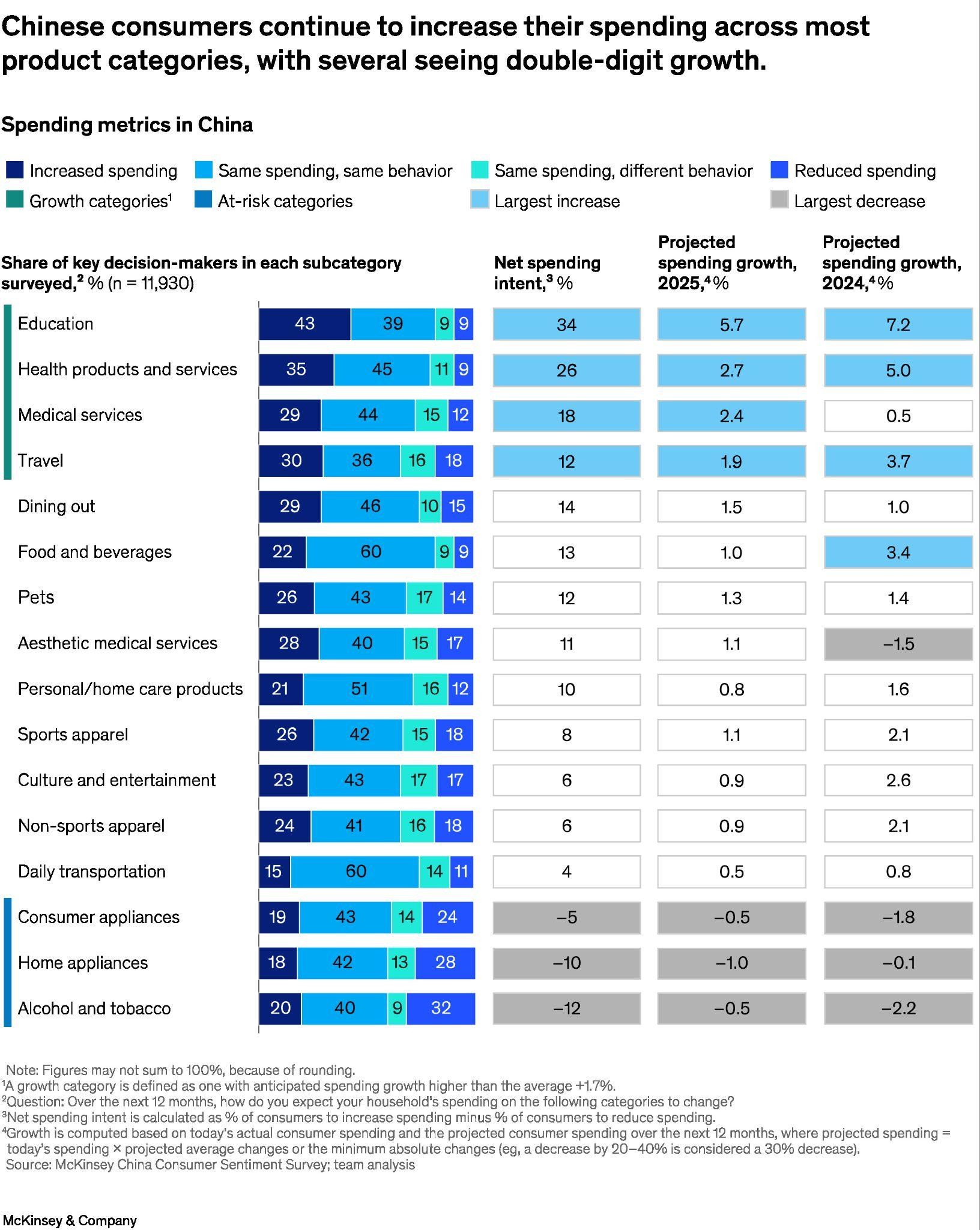
Source: McKinsey & Company. Data highlights a "Value-Plus" shift: while consumers rationalise spending on basics, there is a resilient intent to invest in categories that offer intangible joy and personal fulfilment.
Health, sustainability, and product quality are now baseline expectations for urban millennials and Gen Z. At the same time, purchasing decisions increasingly reflect community influence, peer recommendations, and shared values. Brand narratives that fail to align with these priorities struggle to maintain relevance in an environment shaped by constant social validation.
Luxury consumption in China has shifted from overt status signalling to more nuanced expressions of taste, identity, and purpose. Bain & Company’s 2025 report describes this as a "recalibration" phase, noting that consumers are becoming increasingly selective and consolidating their spending toward a smaller number of preferred brands that deliver perceived "true value". This recalibration reflects a broader redefinition of luxury, where emotional resonance, craftsmanship, and cultural relevance now outweigh sheer brand recognition.
This evolution has opened space for niche designers, heritage brands, and culturally rooted labels that articulate distinct narratives over mere brand prestige. Local brands, in particular, benefit from growing cultural pride and confidence, creating competition that is both creative and commercially formidable. For global players, relevance now depends on storytelling depth and product innovation, rather than logo recognition.
Retail experiences have become strategic assets rather than supporting features. Immersive stores, pop-up exhibitions, and interactive brand spaces are crafted to drive emotional engagement and encourage social sharing.
Technologies such as AR product trials and VR storytelling allow brands to merge entertainment with education, prompting deeper exploration. Experiences generate social currency that spreads across platforms, amplifying visibility through organic peer networks. In this environment, transactions are consequences of engagement, not the main objective.
These behaviour patterns set the stage for platform-led marketing, where Xiaohongshu, WeChat, and Online-to-Offline (O2O) ecosystems translate insights into actionable engagement.

Source: Forever 21 Pop-up Store at Shanghai.A prime example of an immersive brand space designed to drive emotional engagement and generate social currency through organic peer sharing.
China’s digital economy is built on tightly integrated platform ecosystems that merge content, commerce, payments, logistics, and customer service. These platforms do not operate as isolated channels but as interconnected systems that guide consumers from inspiration to fulfilment.
Super-app logic allows users to move seamlessly between browsing, social interaction, transactions, and post-sale service within a single environment. This integration shortens feedback loops, enabling platforms to respond quickly to behavioural shifts. As a result, platform innovation frequently outpaces brand experimentation.
The usual channel-based planning underperforms in this context. Instead, effective marketing in China requires platform-native strategies that reflect how consumers actually navigate digital touchpoints.
To leverage this ecosystem, brands must understand the distinct roles key platforms play. Each one contributes differently to the consumer journey, but together, they form a connected path that moves consumers from insight and inspiration to action.
Xiaohongshu plays a central role in moulding early-stage consideration. Positioned at the intersection of social media, content discovery, and e-commerce, the platform functions as a trusted recommendation engine driven by user-generated content and peer exchange.
Data identifies Xiaohongshu’s core audience as a high-value “middle-young” demographic. With over 300 million monthly active users (MAU) in 2025, the platform has become a primary engine of China’s digital consumption. Further, a significant 70% of this user base consists of post-90s consumers (millennials and Gen Zs) who are the drivers of the "interest economy". This cohort is increasingly captivated by beauty, healthcare, and premium lifestyle content, exhibiting high intentionality in their browsing behaviour.

With a massive user base which includes high-intent consumers, Xiaohongshu serves as a discovery engine where the majority of traffic is driven by active searches rather than passive browsing.
What sets Xiaohongshu apart as a lifestyle inspiration powerhouse is its decentralised recommendation algorithm. Unlike platforms that reward celebrity status or existing follower counts, Xiaohongshu’s algorithm emphasises content quality and helpfulness. New Notes are entered into a Traffic Pool Trial, where they are shown to a small test group of users with matching interests. To advance to a wider audience, a post must meet specific engagement thresholds, typically measured by engagement metrics where saves and shares carry higher weight than simple likes, as they signal deeper consumer intent.
Because the algorithm prioritises helpfulness, effective marketing has shifted from mass-market celebrity endorsements to a seeding strategy, which involves partnering with Key Opinion Leaders (KOLs) and Key Opinion Consumers (KOCs) who translate product features into lifestyle benefits. Success on the platform increasingly relies on the KFS Model (KOL + Feed + Search): leveraging KOLs for authentic storytelling, Feed ads for initial reach, and Search ads to capture high-intent users actively vetting products.
This synergy between search and discovery is most evident in the travel sector, where Xiaohongshu has effectively become a specialised search engine. Platform data reveals that 70% of traffic is now search-driven, with 82% of travellers using the app to meticulously plan their journeys before departure.
This trend is particularly visible for popular destinations like Thailand, which sees over 5 million active posts related to travel tips and itineraries. Rather than broad exposure, successful campaigns for Thai travel brands focus on partnering with a diverse group of local life, lifestyle, and career KOLs who provide first-hand, unfiltered content that proves a destination's real-world appeal. These creators move from being mere advertisers to becoming trusted exploration guides through their documentation of pre-travel preparation and in-travel experiences, especially for nervous yet excited first-time travellers.
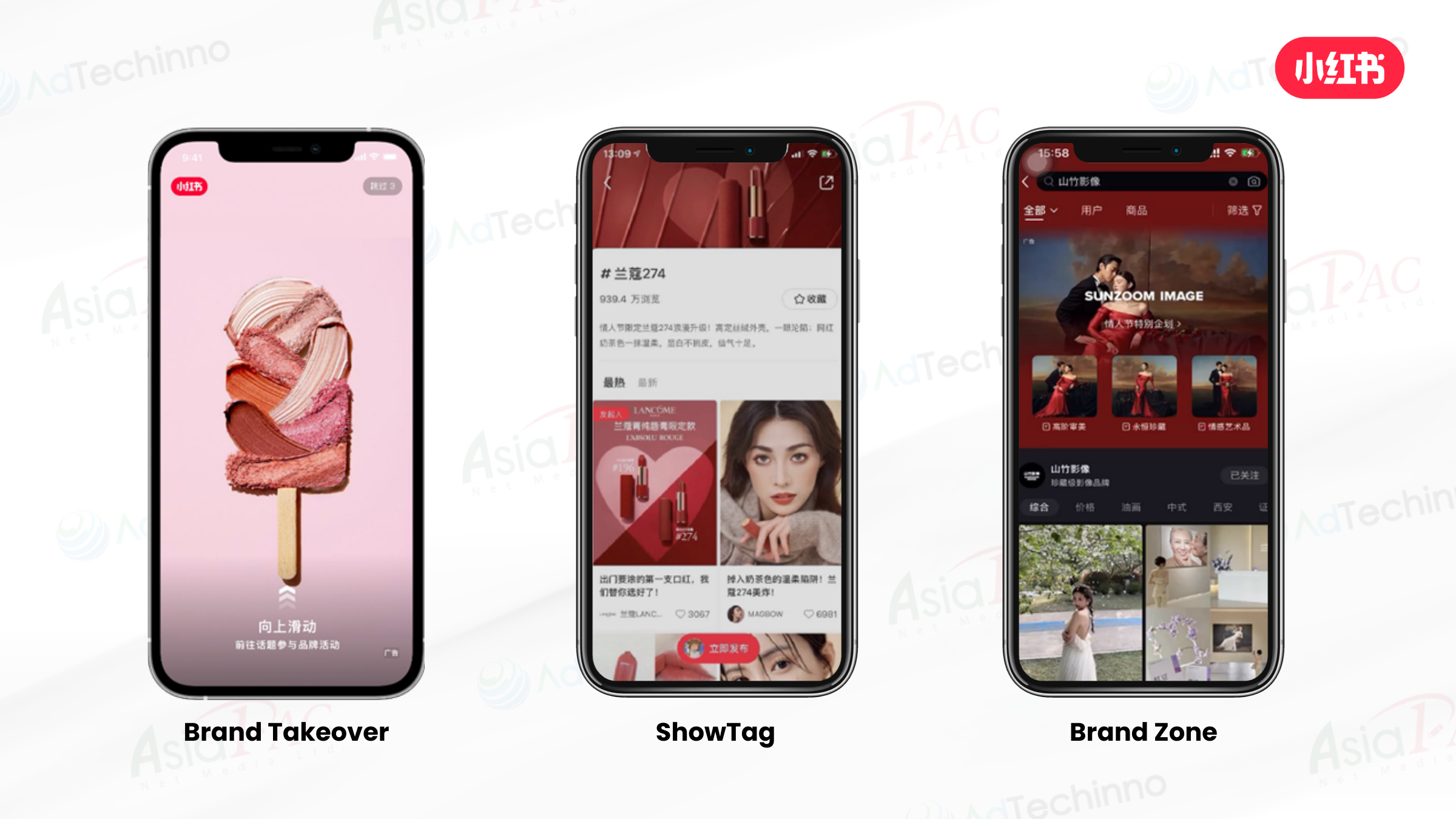
High-impact Xiaohongshu strategies to capture market attention and opportunity
Strategic Takeaway: Xiaohongshu marketing rewards authenticity, cultural fluency, and long-term engagement, not short-term exposure buying.
Interested in learning more? Explore our Xiaohongshu Service to learn how to scale your brand on the platform.
Where Xiaohongshu drives initial discovery, WeChat formalises and nurtures the consumer relationship. The platform operates as essential digital infrastructure rather than a traditional media channel. With over 1.4 billion monthly active users, the super-app integrates social interaction, content distribution, CRM, payments, and commerce within a single, closed-loop environment.

Official accounts, private communities, and mini-programs allow brands to manage relationships across acquisition, engagement, conversion, and retention. Private traffic strategies, which focus on building owned audiences within WeChat, have become central growth assets, reducing dependence on paid media.
Mini-programs facilitate frictionless transactions, enabling purchases, bookings, and loyalty interactions without ever redirecting the user. For high-value segments interested in finance, luxury, and outbound travel, this integration supports personalised engagement at scale. For instance, a user can discover a travel itinerary in an Official Account article, book it via a Mini Program, and receive post-sale support through a dedicated service chat, all within seconds.
An effective WeChat marketing strategy prioritises lifecycle management. Loyalty programmes, community engagement, and reactivation campaigns strengthen brand relationships, generating value that compounds over time.
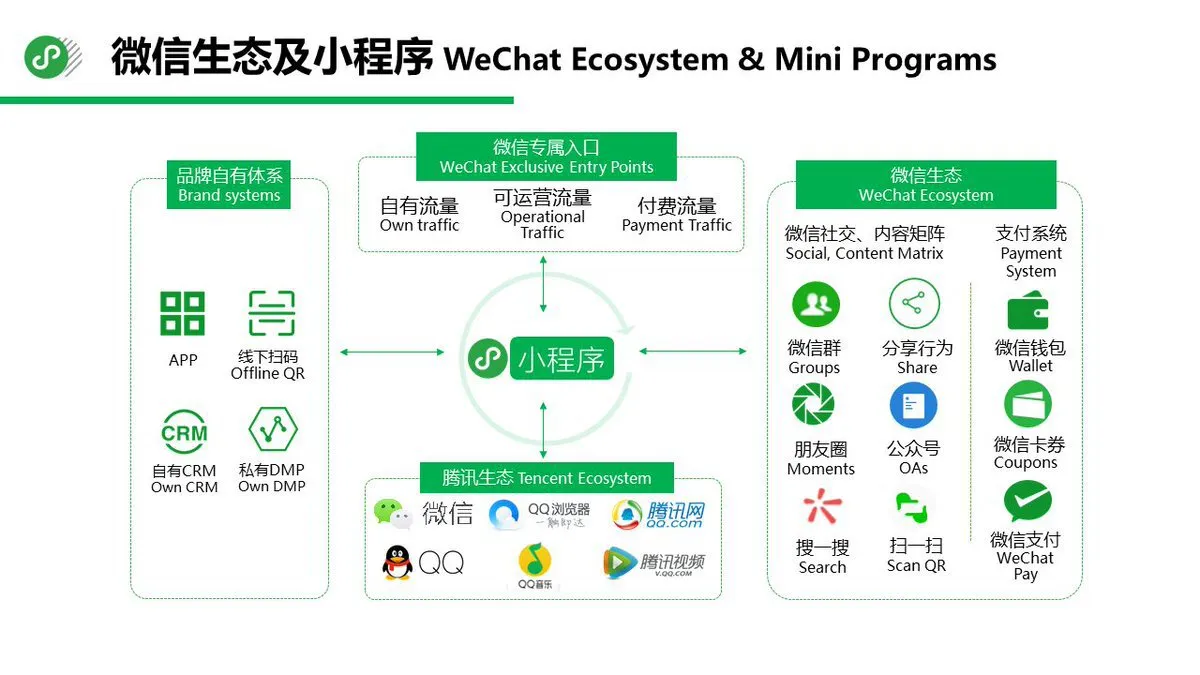
An effective WeChat marketing strategy prioritises lifecycle management. Loyalty programmes, community engagement, and reactivation campaigns strengthen brand relationships, generating value that compounds over time.
Strategic Takeaway: WeChat enables brands to convert discovery into loyalty, deepening relationships that deliver long-term value.

O2O marketing bridges online discovery with offline experience and instant fulfilment. Meituan Dianping, China’s leading local services platform, anchors this ecosystem by integrating food delivery, travel bookings, local retail, and lifestyle services into a single "on-demand" interface.
The rise of instant retail has reshaped consumer expectations around convenience and speed. Urban consumers now prioritise "immediacy as a service", moving beyond next-day delivery to "within-the-hour" fulfilment. In this case, physical stores are transforming from mere showrooms into rapid distribution hubs to support these real-time demands.
Meituan’s integrated ecosystem enables brands to close the loop between awareness, experience, and purchase. This effectively completes the trifecta of discovery, relationship, and fulfilment in the funnel. And with real-time location targeting and occasion-based offers (such as beer delivery paired with high-end dining guides), brands can convert browsing intent into immediate, localised action. As an example use case, a beauty brand can use Meituan to offer "instant samples" delivered to a user's door in 30 minutes, bypassing the traditional friction of e-commerce shipping.
Within a broader China marketing strategy, O2O marketing functions as a core growth driver rather than a tactical layer. It delivers measurable commercial outcomes by leveraging the platform’s massive delivery infrastructure to meet the consumer exactly where (and when) they are.
Strategic Takeaway: Meituan turns "I want" into "I have." It is the critical final step for brands that need to bridge the gap between digital engagement and physical consumption
Success in China no longer hinges on mastering individual platforms. It depends on orchestrating them as a connected ecosystem that reflects how Chinese consumers discover, evaluate, and act. Xiaohongshu shapes perception and trust, WeChat builds relationships and loyalty, while O2O platforms convert intent into immediate fulfilment. When these touchpoints operate in harmony, brands achieve both commercial efficiency and enduring brand equity.
This is where execution becomes decisive. Brands that translate insight into action effectively rely on deep local understanding, specialised influencer marketing, platform fluency, and data-led decision-making. China rewards strategic clarity and cultural intelligence. Those that invest in both are best positioned to turn platform complexity into sustainable competitive advantage.
AsiaPac is an AI-driven, omnichannel digital marketing agency with extensive experience supporting more than 5,000 brands across the Asia Pacific. Its teams work across various sectors, including education, travel and hospitality, retail, finance, and public services, delivering performance-driven strategies rooted in local market insight.
With offices in Hong Kong, Chinese Mainland, Taiwan, Japan, Korea, Singapore, Malaysia, Thailand, Vietnam, and Indonesia, AsiaPac helps brands navigate Asia’s most complex digital ecosystems with confidence and precision.
Beyond strategic insight, we empower brands through our proprietary AI SaaS ecosystem. This includes KOOLER AI for data-led KOL discovery across 200,000+ creators, Kolsify for building culturally resonant digital avatars and social content, and OptAdEasy for AI-driven ad management and automated banner creation. Together with our programmatic DSP, APHub, we ensure that cross-border campaigns are both precise and scalable.
Ready to move from trends to action? Explore how AsiaPac supports brands across China and the region by visiting our Cases page or contacting us at info@asiapac.com.hk or info@adtechinno.com.
GET FREE CONSULTATION NOW